
UROGENITAL RADIOLOGY / ORIGINAL PAPER
Clinically significant prostate cancer in PI-RADS 3 lesions: real-world outcomes of robotic in-bore MRI-guided biopsy
1
Department of Urology, Faculty of Medicine, Medical University of Gdańsk, Gdańsk, Poland
2
Department of Radiology, Faculty of Medicine, Medical University of Gdańsk, Gdańsk, Poland
3
Faculty of Medicine, Medical University of Gdańsk, Gdańsk, Poland
These authors had equal contribution to this work
Submission date: 2026-05-07
Final revision date: 2026-05-11
Acceptance date: 2026-05-12
Publication date: 2026-09-23
Corresponding author
Katarzyna Skrobisz
Department of Radiology, Faculty of Medicine, Medical University of Gdańsk, 17 Mariana Smoluchowskiego St., 80-214 Gdańsk, Poland
Department of Radiology, Faculty of Medicine, Medical University of Gdańsk, 17 Mariana Smoluchowskiego St., 80-214 Gdańsk, Poland
Pol J Radiol, 2026; 91(1): 464-468
KEYWORDS
multiparametric magnetic resonance imagingprostatic neoplasmsimage-guided biopsyrobotic surgical proceduresPI-RADS 3
TOPICS
ABSTRACT
Purpose:
Prostate Imaging Reporting and Data System (PI-RADS) 3 lesions on multiparametric magnetic resonance imaging (mpMRI) represent an equivocal category with an uncertain risk of clinically significant prostate cancer (csPCa), resulting in persistent controversy regarding biopsy indications. Our objective was to evaluate the detection rate of csPCa in patients with PI-RADS 3 only lesions undergoing robot-assisted in-bore magnetic resonance imaging (MRI)-guided prostate biopsy (RA-MRGB) and to identify clinical factors associated with cancer detection.
Material and methods:
This retrospective, single-centre study represents a predefined subgroup analysis of a previously reported institutional cohort. Men undergoing RA-MRGB between January 2021 and March 2025 were screened, and patients with a PI-RADS score of 3 on pre-biopsy mpMRI and no coexisting PI-RADS 4-5 lesions were included. Biopsy decisions were based on multidisciplinary review and shared decision-making. csPCa was defined as International Society of Urological Pathology grade group ≥ 2.
Results:
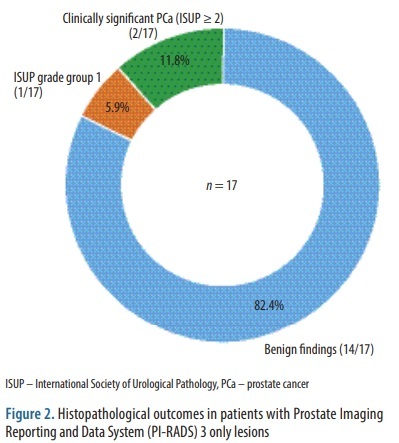
Seventeen of 84 patients with PI-RADS 3 only lesions were identified. Prostate cancer of any grade was detected in 3 patients (17.6%). csPCa was found in 2 patients (11.8%), while 14 patients (82.4%) had benign histopathology. csPCa cases demonstrated heterogeneous clinical profiles, including elevated prostate-specific antigen density or larger lesion size and prior negative biopsy. No single clinical parameter reliably excluded csPCa.
Conclusions:
When evaluated using robotic in-bore MRI-guided biopsy, PI-RADS 3 only lesions demonstrate a low but clinically relevant risk of csPCa. Biopsy decision-making in this group should rely on a multifactorial assessment rather than MRI score alone, and highly precise targeting techniques may enhance confidence in negative results.
Prostate Imaging Reporting and Data System (PI-RADS) 3 lesions on multiparametric magnetic resonance imaging (mpMRI) represent an equivocal category with an uncertain risk of clinically significant prostate cancer (csPCa), resulting in persistent controversy regarding biopsy indications. Our objective was to evaluate the detection rate of csPCa in patients with PI-RADS 3 only lesions undergoing robot-assisted in-bore magnetic resonance imaging (MRI)-guided prostate biopsy (RA-MRGB) and to identify clinical factors associated with cancer detection.
Material and methods:
This retrospective, single-centre study represents a predefined subgroup analysis of a previously reported institutional cohort. Men undergoing RA-MRGB between January 2021 and March 2025 were screened, and patients with a PI-RADS score of 3 on pre-biopsy mpMRI and no coexisting PI-RADS 4-5 lesions were included. Biopsy decisions were based on multidisciplinary review and shared decision-making. csPCa was defined as International Society of Urological Pathology grade group ≥ 2.
Results:
Seventeen of 84 patients with PI-RADS 3 only lesions were identified. Prostate cancer of any grade was detected in 3 patients (17.6%). csPCa was found in 2 patients (11.8%), while 14 patients (82.4%) had benign histopathology. csPCa cases demonstrated heterogeneous clinical profiles, including elevated prostate-specific antigen density or larger lesion size and prior negative biopsy. No single clinical parameter reliably excluded csPCa.
Conclusions:
When evaluated using robotic in-bore MRI-guided biopsy, PI-RADS 3 only lesions demonstrate a low but clinically relevant risk of csPCa. Biopsy decision-making in this group should rely on a multifactorial assessment rather than MRI score alone, and highly precise targeting techniques may enhance confidence in negative results.
REFERENCES (15)
1.
Kasivisvanathan V, Rannikko AS, Borghi M, Panebianco V, Mynderse LA, Vaarala MH, et al. MRI-targeted or standard biopsy for prostate-cancer diagnosis. N Engl J Med 2018; 378: 1767-1777.
2.
Turkbey B, Rosenkrantz AB, Haider MA, Padhani AR, Villeirs G, Macura KJ, et al. Prostate Imaging Reporting and Data System Version 2.1: 2019 update of Prostate Imaging Reporting and Data System Version 2. Eur Urol 2019; 76: 340-351.
3.
Schoots IG. MRI in early prostate cancer detection: how to manage indeterminate or equivocal PI-RADS 3 lesions? Transl Androl Urol 2018; 7: 70-82.
4.
Oerther B, Engel H, Bamberg F, Sigle A, Gratzke C, Benndorf M. Cancer detection rates of the PI-RADSv2.1 assessment categories: systematic review and meta-analysis on lesion level and patient level. Prostate Cancer Prostatic Dis 2022; 25: 256-263.
5.
Camacho A, Salah F, Bay CP, Waring J, Umeton R, Hirsch MS, et al. PI-RADS 3 score: a retrospective experience of clinically significant prostate cancer detection. BJUI Compass 2023; 4: 473-481.
6.
Long Depaquit T, Uleri A, Peyrottes A, Corral R, Toledano H, Chiron P, et al. PI-RADS 3 MRI lesions: are biopsies still necessary? Fr J Urol 2025; 35: 102853. DOI: 10.1016/j.fjurol.2024.102853.
7.
Versalle D, Qi J, Noyes SL, Moriarity A, George A, Cher ML, Lane BR. Michigan Urological Surgery Improvement Collaborative. Practice-level variation in the decision to biopsy Prostate Imaging-Reporting and Data System 3 lesions in favorable-risk prostate cancer patients. Urology 2022; 164: 191-196.
8.
Nguyen TA, Fourcade A, Zambon A, Saout K, Deruelle C, Joulin V, et al. Optimal PSA density threshold and predictive factors for the detection of clinically significant prostate cancer in patient with a PI-RADS 3 lesion on MRI. Urol Oncol 2023; 41: 354.e11-354.e18. DOI: 10.1016/j.urolonc.2023.05.005.
9.
Rajendran I, Lee KL, Thavaraja L, Barrett T. Risk stratification of prostate cancer with MRI and prostate-specific antigen density-based tool for personalized decision making. Br J Radiol 2024; 97: 113-119.
10.
Akpinar C, Kuru Oz D, Oktar A, Suer E, Ozden E, Haliloglu N, et al. Risk-adapted strategy combining magnetic resonance imaging and prostate-specific antigen density to individualize biopsy decision in patients with PI-RADS 3 “Gray Zone” lesions. Clin Genitourin Cancer 2024; 22: 102071. DOI: 10.1016/j.clgc.2024.102071.
11.
Wegelin O, van Melick HHE, Hooft L, Bosch JLHR, Reitsma HB, Barentsz JO, Somford DM. Comparing three different techniques for magnetic resonance imaging-targeted prostate biopsies: a systematic review of in-bore versus magnetic resonance imaging-transrectal ultrasound fusion versus cognitive registration. Is there a preferred technique? Eur Urol 2017; 71: 517-531.
12.
Sandahl M, Sandahl KJ, Marinovskij E, Nielsen TF, Sørensen KD, Borre M, et al. Prostate cancer detection rate of manually operated and robot-assisted in-bore magnetic resonance imaging targeted biopsy. Eur Urol Open Sci 2022; 41: 88-94.
13.
Van Leenders GJLH, van der Kwast TH, Grignon DJ, Evans AJ, Kristiansen G, Kweldam CF, et al. The 2019 International Society of Urological Pathology (ISUP) Consensus Conference on Grading of Prostatic Carcinoma. Am J Surg Pathol 2020; 44: e87-e99. DOI: 10.1097/PAS.0000000000001497.
14.
Rembak-Szynkiewicz J, Wojcieszek P, Hebda A, Mazgaj P, Badziń-ski A, Stasik-Pres G, et al. In-bore MR prostate biopsy – initial experience. Endokrynol Pol 2022; 73: 712-724.
15.
Skrobisz K, Polom W, Rembak-Szynkiewicz J, Matuszewski M. In-bore MRI-guided prostate biopsy: current evidence, clinical applications, and future directions. Pol J Radiol 2026; 91: 68-74.
Share
RELATED ARTICLE
| ISSN: | 1899-0967 |

We process personal data collected when visiting the website. The function of obtaining information about users and their behavior is carried out by voluntarily entered information in forms and saving cookies in end devices. Data, including cookies, are used to provide services, improve the user experience and to analyze the traffic in accordance with the Privacy policy. Data are also collected and processed by Google Analytics tool (more).
You can change cookies settings in your browser. Restricted use of cookies in the browser configuration may affect some functionalities of the website.
You can change cookies settings in your browser. Restricted use of cookies in the browser configuration may affect some functionalities of the website.