

INTERVENTIONAL RADIOLOGY / ORIGINAL PAPER
Morphometric and tortuosity analysis of internal carotid artery harbouring small and large aneurysms: a comprehensive quantitative study
1
Department of Neurosurgery and Neurotraumatology, Faculty of Medicine, Jagiellonian University Medical College, Krakow, Poland
2
Doctoral School of Medical and Health Sciences, Jagiellonian University Medical College, Krakow, Poland
3
Chair of Radiology, Faculty of Medicine, Jagiellonian University Medical College, Krakow, Poland
Submission date: 2026-01-22
Acceptance date: 2026-03-24
Publication date: 2026-10-05
Corresponding author
Maciej Jakub Frączek
Department of Neurosurgery and Neurotraumatology, Faculty of Medicine, Jagiellonian University Medical College, 2 Jakubowskiego St., 30-688 Krakow, Poland
Department of Neurosurgery and Neurotraumatology, Faculty of Medicine, Jagiellonian University Medical College, 2 Jakubowskiego St., 30-688 Krakow, Poland
Pol J Radiol, 2026; 91(1): 478-483
KEYWORDS
TOPICS
ABSTRACT
Purpose:
Intracranial aneurysms display diverse morphologies influenced by parent vessel geometry. The role of 3D vessel tortuosity in differentiating small versus large aneurysms remains underexplored. To comprehensively analyze morphometric and tortuosity parameters of internal carotid arteries (ICA) harboring small (<5mm) versus large (≥5mm) aneurysms using advanced 3D imaging.
Material and methods:
This retrospective study included 48 patients with unruptured unilateral ICA aneurysms (21 small, 27 large) without previous interventions. 3D DSA imaging was used to reconstruct arterial models. We extracted morphometric parameters (radius, length) and tortuosity metrics including relative length (RL), sum-of-angle metric (SOAM), inflection count metric (ICM), and normalized curvature/torsion using validated algorithms.
Results:
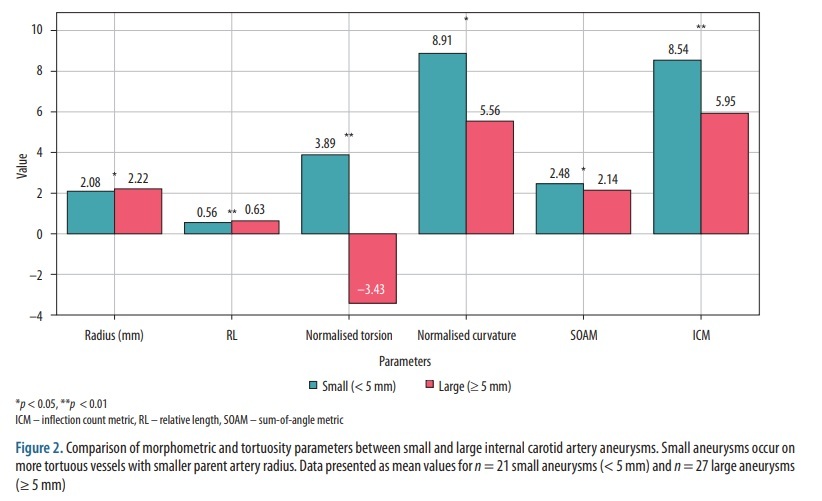
ICA radius was significantly smaller in small aneurysm group (2.08±0.27mm vs 2.22±0.17mm; p=0.039). Vessels with small aneurysms demonstrated higher tortuosity: normalized torsion (3.89±6.96 vs -3.43±9.96; p=0.005), normalized curvature (8.91±4.14 vs 5.56±5.75; p=0.025), lower RL (0.56±0.08 vs 0.63±0.05; p=0.002), higher SOAM (2.48±0.56 vs 2.14±0.51; p=0.034), and elevated ICM (8.54±3.07 vs 5.95±2.60; p=0.004).
Conclusions:
Small ICA aneurysms occur preferentially on more tortuous vessels with smaller parent-artery radius. These findings support integrating 3D vessel geometry metrics into research of aneurysm risk stratification and treatment planning algorithms.
REFERENCES (16)
1.
Sanchez S, Hickerson M, Patel RR, Ghazaleh D, Tarchand R, Paranjape GS, et al. Morphological characteristics of ruptured brain aneurysms: a systematic literature review and meta‐analysis. Stroke Vasc Interv Neurol 2023; 3: e000707. DOI: 10.1161/SVIN.122.000707.
2.
Wang GX, Zhang D, Wang ZP, Yang LQ, Yang H, Li W. Risk factors for ruptured intracranial aneurysms. Indian J Med Res 2018; 147: 51-57.
3.
Rutledge C, Jonzzon S, Winkler EA, Raper D, Lawton MT, Abla AA. Small aneurysms with low PHASES scores account for a majority of subarachnoid hemorrhage cases. World Neurosurg 2020; 139: e580-e584. DOI: 10.1016/j.wneu.2020.04.074.
4.
Froelich JJ, Neilson S, Peters-Wilke J, Dubey A, Thani N, Erasmus A, et al. Size and location of ruptured intracranial aneurysms: a 5-year clinical survey. World Neurosurg 2016; 91: 260-265.
5.
Johnsen LH, Herder M, Vangberg T, Kloster R, Ingebrigtsen T, Isaksen JG, Mathiesen EB. Prevalence of unruptured intracranial aneurysms: impact of different definitions – the Tromsø Study. J Neurol Neurosurg Psychiatry 2022; 93: 902-907.
6.
Bijlenga P, Gondar R, Schilling S, Morel S, Hirsch S, Cuony J, et al. PHASES score for the management of intracranial aneurysm. Stroke 2017; 48: 2105-2112.
7.
Etminan N, Brown RD, Beseoglu K, Juvela S, Raymond J, Morita A, et al. The unruptured intracranial aneurysm treatment score. Neurology 2015; 85: 881-889.
8.
Krzyżewski RM, Kliś KM, Kwinta BM, Stachura K, Popiela T, Gąsowski J. Association of arterial tortuosity with haemodynamic parameters – a computational fluid dynamics study. Brain Spine 2022; 2 (Suppl 2): 101414. DOI: 10.1016/j.bas.2022.101414.
9.
Krzyżewski RM, Kliś KM, Kwinta BM, Łasocha B, Brzegowy P, Popiela TJ, Gąsowski J. Subarachnoid hemorrhage from ruptured internal carotid artery aneurysm: association with arterial tortuosity. World Neurosurg 2022; 166: e84-e92. DOI: 10.1016/j.wneu.2022.06.101.
10.
Juchler N, Schilling S, Bijlenga P, Kurtcuoglu V, Hirsch S. Shape trumps size: image-based morphological analysis reveals that the 3D shape discriminates intracranial aneurysm disease status better than aneurysm size. Front Neurol 2022; 13: 809391. DOI: 10.3389/fneur.2022.809391.
11.
Kim HJ, Song HN, Lee JE, Kim YC, Baek IY, Kim YS, et al. How cerebral vessel tortuosity affects development and recurrence of aneurysm: outer curvature versus bifurcation type. J Stroke 2021; 23: 213-222.
12.
Kliś K, Krzyżewski R, Kwinta B, Stachura K, Gąsowski J. Tortuosity of the internal carotid artery and its clinical significance in the development of aneurysms. J Clin Med 2019; 8: 237. DOI: 10.3390/jcm8020237.
13.
Piccinelli M, Veneziani A, Steinman DA, Remuzzi A, Antiga L. A framework for geometric analysis of vascular structures: application to cerebral aneurysms. IEEE Trans Med Imaging 2009; 28: 1141-1155.
14.
Kliś KM, Wójtowicz D, Kwinta BM, Stachura K, Popiela TJ, Frą-czek MJ, et al. Association of arterial tortuosity with hemodynamic parameters – a computational Fluid Dynamics Study. World Neurosurg 2023; 180: e69-e76. DOI: 10.1016/j.wneu.2023.07.152.
15.
Li R, Zhou P, Kao E, Zhu C, Mossa-Basha M, Wang Y. Unilateral cerebral arterial tortuosity: associated with aneurysm occurrence, but potentially inversely associated with aneurysm rupture. Eur J Radiol 2023; 165: 110941. DOI: 10.1016/j.ejrad.2023.110941. .
16.
Benemerito I, Ewbank F, Narracott A, Villa-Uriol MC, Narata AP, Patel U, et al. Computational fluid dynamics and shape analysis enhance aneurysm rupture risk stratification. Int J Comput Assist Radiol Surg 2025; 20: 31-41.
Share
RELATED ARTICLE
| ISSN: | 1899-0967 |

We process personal data collected when visiting the website. The function of obtaining information about users and their behavior is carried out by voluntarily entered information in forms and saving cookies in end devices. Data, including cookies, are used to provide services, improve the user experience and to analyze the traffic in accordance with the Privacy policy. Data are also collected and processed by Google Analytics tool (more).
You can change cookies settings in your browser. Restricted use of cookies in the browser configuration may affect some functionalities of the website.
You can change cookies settings in your browser. Restricted use of cookies in the browser configuration may affect some functionalities of the website.