

CHEST RADIOLOGY / ORIGINAL PAPER
A radiomics-clinical nomogram for predicting surgeon-selected resection type in early-stage lung cancer: a single-center retrospective study
1
Department of Thoracic Surgery, the Second Affiliated Hospital of Chongqing Medical University, Chongqing, China
2
Department of Cancer Center, the Second Affiliated Hospital of Chongqing Medical University, Chongqing, China
3
Department of Oncology and Hematology, The First People's Hospital of Longquanyi District, Chengdu, China
Submission date: 2026-01-25
Acceptance date: 2026-03-09
Publication date: 2026-10-26
Corresponding author
Bing Wang
Department of Thoracic Surgery, the Second Affiliated Hospital of Chongqing Medical University, Chongqing, China
Department of Thoracic Surgery, the Second Affiliated Hospital of Chongqing Medical University, Chongqing, China
Pol J Radiol, 2026; 91(1): 514-525
KEYWORDS
TOPICS
ABSTRACT
Purpose:
Selecting lobectomy versus parenchyma-sparing limited resection for early-stage lung cancer remains challenging because clinicians must balance oncologic adequacy with preservation of pulmonary function. Current guideline-based decisions rely largely on tumor size and clinical judgment, and individualized quantitative assessment is limited. We developed and internally validated a CT radiomics–clinical nomogram to estimate the probability of lobectomy versus limited resection as selected in routine practice.
Material and methods:
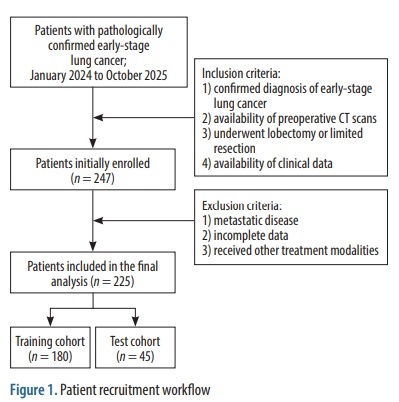
We retrospectively enrolled 225 patients with early-stage lung cancer (training cohort, n = 180; test cohort, n = 45). From preoperative CT, 1,834 radiomic features were extracted, and five features were selected using LASSO with 10-fold cross-validation to construct a radiomics signature. Candidate clinical variables available before surgery were assessed using multivariable logistic regression to derive a clinical signature. The radiomics and clinical signatures were then integrated into a logistic regression nomogram. Model performance was evaluated using area under the receiver operating characteristic curve (AUC), calibration, decision curve analysis (DCA), and DeLong’s test.
Results:
In the test cohort, the nomogram achieved an AUC of 0.876, outperforming the radiomics-only model (AUC = 0.806; p = 0.0008) and the clinical-only model (AUC = 0.753; p < 1×10⁻⁹). Calibration showed good agreement between predicted and observed resection selection (Hosmer–Lemeshow p = 0.72). DCA indicated that the nomogram yielded a higher net benefit than the alternative models across threshold probabilities of 0-50%.
Conclusions:
This radiomics-clinical nomogram provides an interpretable estimate of the likelihood of lobectomy versus limited resection and may support preoperative planning and multidisciplinary discussion. External and multicenter validation is warranted.
REFERENCES (28)
1.
Bray F, Laversanne M, Sung H, Ferlay J, Siegel RL, Soerjomataram I, et al. Global cancer statistics 2022: GLOBOCAN estimates of incidence and mortality worldwide for 36 cancers in 185 countries. CA Cancer J Clin 2024; 74: 229-263.
2.
Spicer JD, Cascone T, Wynes MW, Ahn MJ, Dacic S, Felip E, et al. Neoadjuvant and adjuvant treatments for early stage resectable NSCLC: consensus recommendations from the International Association for the Study of Lung Cancer. J Thorac Oncol 2024; 19: 1373-1414.
3.
Bertolaccini L, Tralongo AC, Del Re M, Facchinetti F, Ferrara R, Franchina T, et al. Segmentectomy vs. lobectomy in stage IA non-small cell lung cancer: a systematic review and meta-analysis of perioperative and survival outcomes. Lung Cancer 2024; 197: 107990. DOI: 10.1016/j.lungcan.2024.107990.
4.
Saji H, Okada M, Tsuboi M, Nakajima R, Suzuki K, Aokage K, et al. Segmentectomy versus lobectomy in small-sized peripheral non-small-cell lung cancer (JCOG0802/WJOG4607L): a multicentre, open-label, phase 3, randomised, controlled, non-inferiority trial. Lancet 2022; 399: 1607-1617.
5.
Lei X, Zhou N, Zhang H, Li T, Ren F, Zhang B, et al. Lobe-specific analysis of sublobar lung resection for NSCLC patients with tumors ≤ 2 cm. Cancers (Basel) 2022; 14: 3265. DOI: 10.3390/cancers-14133265.
6.
Lim E, Harris RA, McKeon HE, Batchelor TJ, Dunning J, Shackcloth M, et al. Impact of video-assisted thoracoscopic lobectomy versus open lobectomy for lung cancer on recovery assessed using self-reported physical function: VIOLET [Internet]. Health Technol Assess 2022; 26: 1-162.
7.
Altorki N, Wang X, Damman B, Mentlick J, Landreneau R, Wigle D, et al. Lobectomy, segmentectomy, or wedge resection for peripheral clinical T1aN0 non-small cell lung cancer: a post hoc analysis of CALGB 140503 (Alliance). J Thorac Cardiovasc Surg 2024; 167: 338-347e1. DOI: 10.1016/j.jtcvs.2023.07.008.
8.
Tasoudis P, Loufopoulos G, Manaki V, Doerr M, Agala CB, Long JM, et al. Long term outcomes after lobar versus sublobar resection for patients with non-small cell lung cancer: systematic review and individual patient data meta-analysis. Lung Cancer 2024; 195: 107929. DOI: 10.1016/j.lungcan.2024.107929.
9.
Shen H, Jin Y, Zhao H, et al. Potential clinical utility of liquid biopsy in early-stage non-small cell lung cancer. BMC Med 2022; 20: 480. DOI: 10.1186/s12916-022-02681-x.
10.
Davies MPA, Sato T, Ashoor H, Hou L, Liloglou T, Yang R, et al. Plasma protein biomarkers for early prediction of lung cancer. EBioMedicine 2023; 93: 104686. DOI: 10.1016/j.ebiom.2023.104686.
11.
Avanzo M, Stancanello J, Pirrone G, Sartor G. Radiomics and deep learning in lung cancer. Strahlenther Onkol 2020; 196: 879-887.
12.
Chen M, Copley SJ, Viola P, Lu H, Aboagye EO. Radiomics and artificial intelligence for precision medicine in lung cancer treatment. Semin Cancer Biol 2023; 93: 97-113.
13.
Gillies RJ, Schabath MB. Radiomics improves cancer screening and early detection. Cancer Epidemiol Biomarkers Prev 2020; 29: 2556-2567.
14.
Wu YJ, Wu FZ, Yang SC, Tang EK, Liang CH. Radiomics in early lung cancer diagnosis: from diagnosis to clinical decision support and education. Diagnostics (Basel) 2022; 12: 1064. DOI: 10.3390/diagnostics12051064.
15.
Whybra P, Zwanenburg A, Andrearczyk V, Schaer R, Apte AP, Ayotte A, et al. The image biomarker standardization initiative: standardized convolutional filters for reproducible radiomics and enhanced clinical insights. Radiology 2024; 310: e231319. DOI: 10.1148/radiol.231319.
16.
Liu C, Zhao W, Xie J, Lin H, Hu X, Li C, et al. Development and validation of a radiomics-based nomogram for predicting a major pathological response to neoadjuvant immunochemotherapy for patients with potentially resectable non-small cell lung cancer. Front Immunol 2023; 14: 1115291. DOI: 10.3389/fimmu.2023.1115291.
17.
Peng L, Zhang X, Liu J, Liu Y, Huang J, Chen J, et al. MRI-radiomics-clinical-based nomogram for prenatal prediction of the placenta accreta spectrum disorders. Eur Radiol 2022; 32: 7532-7543.
18.
Miller M, Hanna N. Advances in systemic therapy for non-small cell lung cancer. BMJ 2021; 375: n2363. DOI: 10.1136/bmj.n2363.
19.
Hattori A, Suzuki K, Takamochi K, Wakabayashi M, Sekino Y, Tsutani Y, et al. Segmentectomy versus lobectomy in small-sized peripheral non-small-cell lung cancer with radiologically pure-solid appearance in Japan (JCOG0802/WJOG4607L): a post-hoc supplemental analysis of a multicentre, open-label, phase 3 trial. Lancet Respir Med 2024; 12: 105-116.
20.
Lee JH, Park CM, Kim H, Hwang EJ, Park J, Goo JM. Persistent part-solid nodules with solid part of 5 mm or smaller: Can the ‘follow-up and surgical resection after interval growth’ policy have a negative effect on patient prognosis? Eur Radiol 2017; 27: 195-202.
21.
Zhang Y, Fu F, Chen H. Management of ground-glass opacities in the lung cancer spectrum. Ann Thorac Surg 2020; 110: 1796-1804.
22.
Eguchi T, Kameda K, Lu S, Bott MJ, Tan KS, Montecalvo J, et al. Lobectomy is associated with better outcomes than sublobar resection in spread through air spaces (STAS)-positive T1 lung adenocarcinoma: a propensity score-matched analysis. J Thorac Oncol 2019; 14: 87-98.
23.
Ren Y, Xie H, Dai C, She Y, Su H, Xie D, et al. Prognostic impact of tumor spread through air spaces in sublobar resection for 1A lung adenocarcinoma patients. Ann Surg Oncol 2019; 26: 1901-1908.
24.
Bassi M, Russomando A, Vannucci J, Ciardiello A, Dolciami M, Ricci P, et al. Role of radiomics in predicting lung cancer spread through air spaces in a heterogeneous dataset. Transl Lung Cancer Res 2022; 11: 560-571.
25.
Demircioglu A. Reproducibility and interpretability in radiomics: a critical assessment. Diagn Interv Radiol 2025; 31: 321-328.
26.
Xu W, Liu X, Yan C, Abdurahmane G, Lazibiek J, Zhang Y, et al. The prognostic value and model construction of inflammatory markers for patients with non-small cell lung cancer. Sci Rep 2024; 14: 7568. DOI: 10.1038/s41598-024-57814-4.
27.
Zeng C, Ji J, Huang Y, Peng Y, Zhang X, Yang Z, et al. A novel scoring system to predict acute radiation enteritis recovery in cervical cancer patients undergoing concurrent chemoradiotherapy: a Southwest China cohort study. Int J Gen Med 2024; 17: 5907-5919.
28.
Ji Z, Cui Y, Peng Z, Gong J, Zhu HT, Zhang X, et al. Use of radiomics to predict response to immunotherapy of malignant tumors of the digestive system. Med Sci Monit 2020; 26: e924671. DOI: 10.12659/MSM.924671.
Share
RELATED ARTICLE
| ISSN: | 1899-0967 |

We process personal data collected when visiting the website. The function of obtaining information about users and their behavior is carried out by voluntarily entered information in forms and saving cookies in end devices. Data, including cookies, are used to provide services, improve the user experience and to analyze the traffic in accordance with the Privacy policy. Data are also collected and processed by Google Analytics tool (more).
You can change cookies settings in your browser. Restricted use of cookies in the browser configuration may affect some functionalities of the website.
You can change cookies settings in your browser. Restricted use of cookies in the browser configuration may affect some functionalities of the website.